We Count Facts while the Deathwatch Beetle Counts Our Seconds

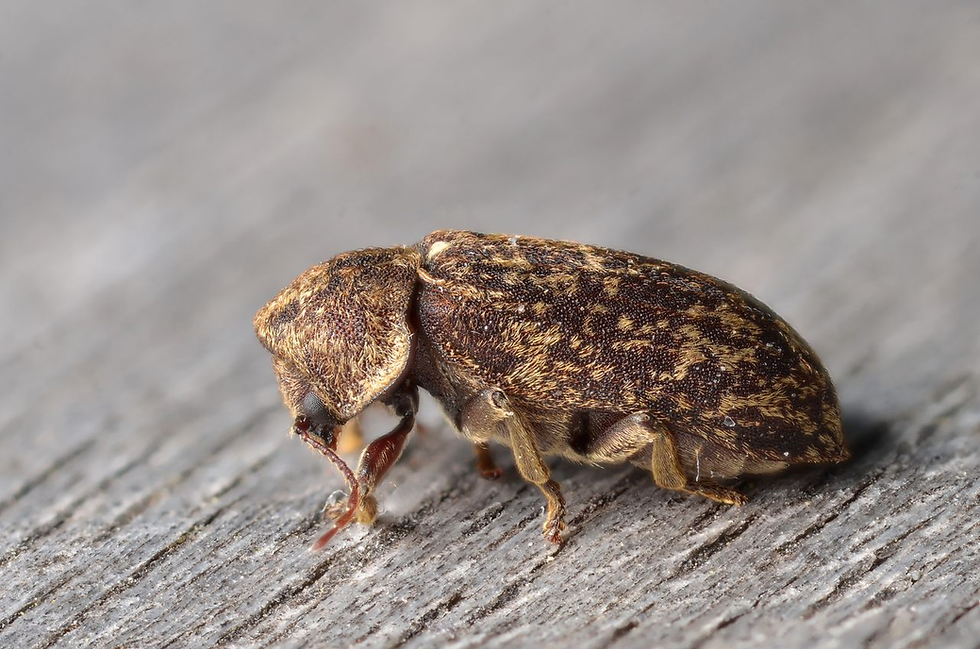
In the vast world of insects, this species of beetle is a candidate for one of the coolest nicknames. Hailing from the Anobiidae family, the Deathwatch Beetle (Xestobium Rufovillosum) is a species of beetle with an interesting backstory to match its name (Woodland Trust). It is a small beetle with the adult's size ranging from 5-9 mm (Wildlife trusts). It's a brown hairy beetle with a cylindrical shape that lives in trees.
It is found widely in the UK and is less prevalent in the North of the UK (Wildlife Trusts). It is also found in parts of North America and West Asia in similar habitats (Wikipedia). The Deathwatch beetle resides in dead wood and has specific preferences for the type of wood and its conditions.
This beetle tends to reside in dead hardwood but strongly favors oak. The best oaks are those that are at least 100 years old and softened by damp conditions or fungi.
To spot this beetle, the best time is in the spring when the new adults emerge from holes that are 3-4mm in diameter. Since the Deathwatch Beetle is not a great flier, you will most likely find it crawling on the dead oak wood it emerged from (Woodland Trust). Its name comes from the noise it creates inside the wood and the folklore behind it.

The adult burrows through the wood. To find a mate, the Deathwatch Beetle creates a ticking noise by hitting its head or jaws against the wood. This sound attracts females, and once the male encounters a female, they will breed on the spot (Woodland Trust). The female lays her eggs in the crevices of the wood. The female will have laid somewhere between 40 and 80 eggs by the end of her life.
The eggs are sticky and white. They narrow into a dull point at one end and only reach a length of 0.7mm (Wikipedia). The eggs hatch into the larval stage, which is the longest stage of the life cycle, compared to the adult stage, which only lasts a few weeks; the egg stage lasts around a month. The larval stage can last from 1 to 10 or more years. During this entire period, the larvae are gnawing and feeding on the wood in which they were laid (Wikipedia).
After all this eating, the larva pupates and eventually emerges as an adult. Fun fact: the Deathwatch Beetle doesn't eat anything as an adult. All eating and consumption occurs during the larval stage.
The story behind the Deathwatch Beetle's name is a very ominous one. In some stories, people heard ticking noises during long sleepless nights and attributed the sound to the countdown to their deaths (Wildlife Trusts). Other stories describe ticking noises coming from the rooms or even bedframes housing dying people or relatives (Atlas Obscura). The ticking noises were an indicator that the person's time had come. The sound's association with dark omens has since been disproven, thus clearing this beetle's name. Many famous authors have referenced the myths, however. Henry David Thoreau, Mark Twain, and Edgar Allan Poe are all authors who have drawn inspiration from this species. Edgar Allen Poe's most notable work, The Tell-Tale Heart, references the sound with the deafening ticking throughout the plot.
However, this doesn't mean the beetle is completely harmless; the Deathwatch Beetle eats away at wood that may be used as supports or be the literal structure of buildings. This deteriorates the wood's integrity and can cause structures to collapse. No confirmed building collapses have been directly caused by this beetle, but it is still a threat to a lot of monuments and heritage structures consisting of old wood. There are ways to prevent infestation, such as regular checks and filling crevices with wax. However, the Deathwatch Beetle is resistant to common insecticides; the most effective method of control is to use healthy, new wood or, where possible, avoid wood entirely (The Guardian). Searching for the sound the Deathwatch Beetle makes is highly recommended - I promise you won't be disappointed.
Bibliography
https://www.theguardian.com/environment/2022/may/04/specieswatch-beware-the-deathwatch-beetle (The Guardian)
https://www.wildlifetrusts.org/wildlife-explorer/invertebrates/beetles/deathwatch-beetle (Wildlife Trusts)
https://www.woodlandtrust.org.uk/trees-woods-and-wildlife/animals/beetles/deathwatch-beetle/ (Woodland Trust)
https://www.atlasobscura.com/articles/deathwatch-beetle-omen (Atlas Obscura)
https://en.wikipedia.org/wiki/Deathwatch_beetle (Wikipedia)


Comments