Living Bioweapon: The Bombardier Beetle


The Bombardier Beetles are of the Beetle Subfamilies Brachininae and Paussinae. They are a very small species, only growing to an inch in size (National Geographic). However, as has been seen in the field of insects many times, size doesn't have to matter. You see, the Bombardier Beetle is famous for its defense mechanism against predators. It has the ability to fire a synthesized emission of a scalding and smelly substance from its backside. This mechanism is the trademark of the Bombardier Beetle and is integral to its survival.
The Bombardier Beetle can be found on five continents of the planet, typically hidden in moist and shady places (NWF). These spots could be under tree litter on the forest floor, under rocks, or in grasslands and fields. Some species of the Bombardier Beetle can even be found in wetlands (NWF). They are largely stable in population; thus, finding one is cool, but it isn't that rare. But when found, you must be careful. Famous Naturalist Charles Darwin, who founded the idea of evolution, found out the hard way.
While searching for insect species, Darwin stumbled upon two different specimens of
Carabidae. Picking up one in each hand, he later discovered the rare Panagaeus cruxmajor
(Crucifix Ground Beetle). Unable to decide which Carabidae specimen to give up, he decided to hold one between his teeth and pick up the Panagaeus cruxmajor. What resulted was that the insect between his teeth released its defense mechanism. The insect between his teeth was a species of Bombardier Beetle. The specimen sprayed its acid down Darwin's throat, causing immediate pain (Charles Darwin's letter to naturalist Leonard Jenyns in 1846). The acid is very pungent in smell, said to be similar to iodine or intense vinegar according to scientists and victims alike (Beetleforum). The acid consists of two chemicals: hydrogen peroxide and hydroquinone. The Bombardier Beetle releases the explosive gas at a record temperature of 212°F. However, hydrogen peroxide and hydroquinone don't explode when they mix (Shape of Life). The powerful reaction only occurs when the Bombardier Beetle adds enzymes to the mixture.
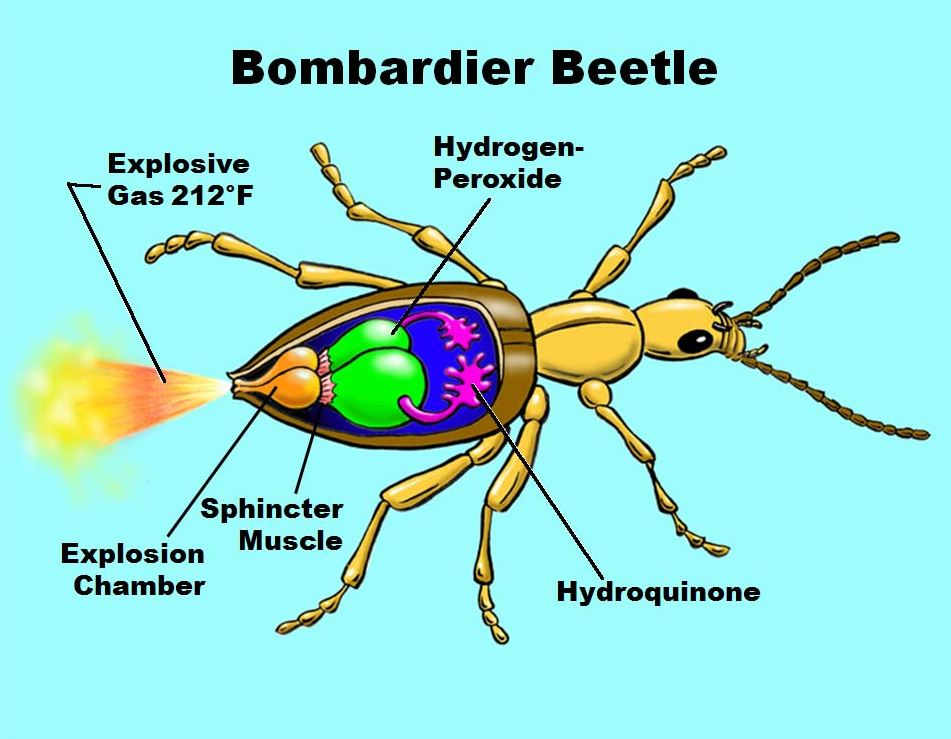
The hydrogen peroxide and hydroquinone are held in separate organs. When about to be released, they are mixed together. A brown enzyme fluid is collected and released through single-cell openings in the sphincter muscle. This enzyme fluid causes the hydrogen peroxide and hydroquinone to combust. The tough chitin walls of the sphincter muscle protect the insides of the Bombardier Beetle as a hatch-like door opens to release the mixture (Shape of Life).
The Bombardier Beetle is actually lethally accurate with the spray and can easily rapid-fire the mixture.
The main function of this power is defense from predators. This doesn't secure its safety, as in many cases, it is forced to make a last stand. Larger predators such as frogs often chomp up these beetles at the cost of intense pain, vomiting, or even death. However, it is not uncommon for a Bombardier Beetle to be vomited out alive and unscathed after being swallowed by frogs. They have been shown to enter the digestive tract of the frogs and still manage to survive after being regurgitated (Natural History Museum).
For their role as predators, they simply hunt using sight and touch. Standard mandibles are their most common way of catching and feasting on small insects.
In their adulthood, they only live for a few weeks. In that time, they will breed. The male releases its sperm into the female reproductive tract. This fertilizes the eggs, and the most common result is the laying of eggs in and under decaying plant material. The larvae hatch as worm-like organisms. Instead of developing into a pupal stage, the larvae undergo multiple molting stages until they reach full adult maturity (National Geographic).
Being a walking bioweapon that can be found all over the world has benefited the
Bombardier Beetles effectively. Unlike many other species of insect, they are not considered endangered and have been around long enough to shoot their acid down Charles Darwin's throat. However, there is still much to learn about how it truly survives its own attacks or how it can defeat larger predators after being swallowed.
Bibliography
https://www.nwf.org/Educational-Resources/Wildlife-Guide/Invertebrates/Bombardier-Beetles (NWF)
https://www.nationalgeographic.com/animals/invertebrates/facts/bombardier-beetle (National Geographic)
https://www.nhm.ac.uk/discover/bombardier-beetles-and-their-caustic-chemical-cannon.html (Natural History Museum)
https://www.shapeoflife.org/news/featured-creature/2023/10/03/bombardier-beetle (Shape of Life)
https://beetleforum.net/threads/me-and-my-niece-got-sprayed-by-a-bombardier-beetle.5195/ (Beetleforum)


Comments